
The Hidden Danger Destroying Homes in McKinney
Water pooling against your foundation is the #1 cause of structural failure in McKinney. The expansive clay acts like a sponge, swelling with immense hydraulic pressure that literally lifts your home upward.
The historic core is pier and beam, and those homes need a fundamentally different approach: crawl space access, beam and joist assessment, moisture control. West McKinney is post-2000 slab, much of it post-tension. We do a great deal of both here, and the evaluation determines which conversation we are having.
Why Waiting Will Cost You Thousands
Foundation failure doesn't fix itself; it accelerates. What starts as a hairline crack in your drywall can quickly turn into thousands of dollars in sheared plumbing lines beneath your slab. The longer you wait to address the shifting soil in McKinney, the more expensive the collateral damage becomes. A+ Foundation Repair offers free evaluations to catch these issues early.
"A+ Foundation Repair completely saved our home. The cracks in the brick were terrifying, but their crew came out to McKinney, explained everything clearly, and the repair was flawless. I can finally sleep at night knowing our home is secure."
- Verified Customer in North TexasThe Science of McKinney Soil
The clay soils of McKinney have an incredibly high plasticity index. When it rains, they absorb water and expand rapidly, exerting thousands of pounds of hydrostatic pressure against your concrete. By controlling where the water flows, A+ Foundation Repair mitigates this destructive swelling.
McKinney sits on Blackland Prairie clay and runs through the same seasonal shrink-swell cycle as the rest of Collin County. Movement concentrates around the perimeter of a slab, where soil dries fastest in summer and rewets fastest in spring, which is why McKinney settlement so often shows up first as a door that will not latch at one corner of the house.
The older neighborhoods around the square were laid out long before modern drainage standards, and many have mature trees within a few feet of the structure. Newer west-side subdivisions have engineered drainage but often sit on fill, which introduces its own settlement behavior.
Independent sources: soil classifications for Collin County can be looked up through the USDA Web Soil Survey, and Texas A&M AgriLife Extension publishes guidance on managing expansive soils around Texas foundations.
The A+ Foundation Repair Difference
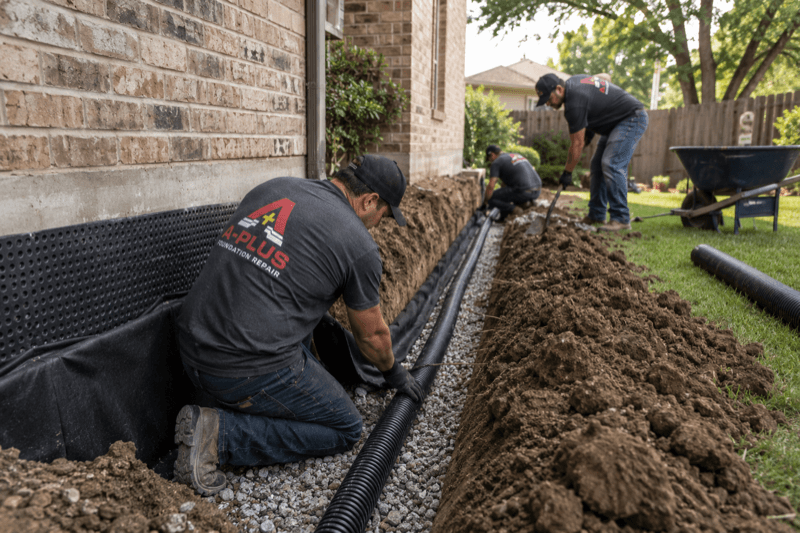
We design and install heavy-duty French drains and surface catch basins tailored to your specific yard's slope, safely whisking destructive rainwater far away from your McKinney property.
On historic McKinney homes we are conservative about lift. A house that has stood since the 1890s has found an equilibrium, and aggressive releveling risks doing more damage to original material than the settlement itself ever did. Stabilization first, elevation recovery second, and only as much as the structure will take.
Protecting your property value in McKinney
Proper drainage is the cheapest insurance policy for your McKinney home. Protecting your foundation with an engineered French drain prevents tens of thousands of dollars in structural repairs, keeping your property pristine and highly valued.
Permits and inspections in McKinney
Structural repair generally requires a permit in McKinney, and the city's historic districts can carry additional review. On a historic property we establish that up front, because it affects both the schedule and the approach.
Where we do drainage system installation in McKinney
We serve McKinney from the historic square out through Stonebridge Ranch and the western subdivisions.
- Historic Downtown McKinney
- Stonebridge Ranch
- Craig Ranch
- Adriatica
- Tucker Hill
- West McKinney
- East McKinney
Custom Drainage Systems in McKinney: Frequently Asked Questions
Specific answers about drainage system installation for McKinney homeowners, including local soil conditions, permitting in Collin County, and what drives the price.
How does drainage affect my foundation?
It is one of the largest controllable factors. North Texas clay expands when it absorbs water and contracts when it dries. Water pooling against one side of your home keeps that soil swollen while the opposite side dries out, and that differential is what pulls a foundation apart. Controlling where water goes controls how much the soil moves.
What is a French drain and do I need one?
A French drain is a perforated pipe in a gravel-filled trench that collects subsurface water and carries it away from the structure. You likely need one if water stands in your yard for more than a day after rain, if soil stays soggy against the foundation, or if your lot slopes toward the house instead of away from it.
How much does a drainage system cost?
It depends on the length of drain required, the depth, how far the discharge point is, and what has to be crossed to get there. A short run along one side of a house is a modest job; a full-perimeter system with multiple catch basins is a larger one. We design to your lot's actual slope rather than selling a standard package.
What is the difference between surface drains and French drains?
Surface drains, including catch basins, capture water sitting on top of the ground and are the right tool for low spots that pond. French drains intercept water moving through the soil below grade. Many properties need both, and using only one where the other is required is a common reason a drainage fix underperforms.
Why is drainage system installation needed so often in McKinney?
McKinney's Blackland clay drives the same seasonal shrink-swell cycle seen across Collin County, with movement concentrated around the perimeter of a slab where soil dries fastest. Homes in McKinney sit directly on that ground, and drainage system installation addresses the damage it causes rather than just the cosmetic symptoms above it.
How much does drainage system installation cost in McKinney?
Pricing depends on the size of the affected area, how far the structure has moved, and what the Blackland Prairie clay beneath your property requires. We do not quote McKinney jobs over the phone without measuring, because a number given sight-unseen is a guess. Evaluations are free and the written estimate is what you pay.
Do I need a permit for drainage system installation in McKinney?
Structural work generally requires a permit in Collin County municipalities, and some cities also require an engineer's report. We pull whatever permits McKinney requires as part of the job. Non-structural work such as flatwork or drainage may have different requirements, and we confirm before starting.
How quickly can you get to my McKinney property?
McKinney is inside our regular service area and we schedule evaluations there continuously. Call (972) 436-2595 and we will book the soonest available slot. If you have an active, fast-moving problem, tell us when you call and we will prioritize it.
Is drainage system installation in McKinney covered by a warranty?
Our foundation leveling work carries a Lifetime Transferable Warranty, and other services carry warranties appropriate to the work performed. We explain exactly what your McKinney job is covered for, in writing, before you sign anything.
Thousands of Satisfied DFW Homeowners
Don't just take our word for it. See why A+ Foundation Repair is the highest-rated structural contractor in McKinney.
Trusted by Homeowners
Don't just take our word for it. See what our clients are saying.
Texas Weather Changes Fast. Don't Wait.
Foundation damage doesn't fix itself—it only gets more expensive. Protect your home's value before the next heavy rain cycle shifts your soil. Get a completely free, no-pressure structural evaluation today.