
The Hidden Danger Destroying Homes in Fort Worth
During the hot, dry Fort Worth summers, massive tree roots desperately seek moisture, growing directly under your foundation and aggressively sucking the soil dry until your concrete collapses.
Fort Worth's pre-war neighborhoods are largely pier and beam, and in Fairmount and Ryan Place we spend as much time on rotted sill beams and settled interior piers as we do on anything structural. Post-1980 construction on the north and west sides is slab-on-grade, and those homes present the standard perimeter settlement pattern instead. The repair method follows the foundation type, not the ZIP code.
Why Waiting Will Cost You Thousands
Foundation failure doesn't fix itself; it accelerates. What starts as a hairline crack in your drywall can quickly turn into thousands of dollars in sheared plumbing lines beneath your slab. The longer you wait to address the shifting soil in Fort Worth, the more expensive the collateral damage becomes. A+ Foundation Repair offers free evaluations to catch these issues early.
"A+ Foundation Repair completely saved our home. The cracks in the brick were terrifying, but their crew came out to Fort Worth, explained everything clearly, and the repair was flawless. I can finally sleep at night knowing our home is secure."
- Verified Customer in North TexasThe Science of Fort Worth Soil
A mature tree in Fort Worth can transpire hundreds of gallons of water per day. When a drought hits, its roots tunnel under your foundation seeking the trapped moisture. This localized desiccation causes only that specific section of the house to sink. A+ Foundation Repair's barriers sever this destructive relationship.
The city sits on the Fort Worth Prairie, where a mantle of expansive clay covers limestone bedrock of the Walnut and Goodland formations. What matters practically is the depth to that rock: on the west side it can be shallow enough that piers reach refusal quickly, while east toward the Trinity the clay runs considerably deeper. Two homes on the same street can need different pier depths, which is why a quote given over the phone for a Fort Worth address is a guess.
The Trinity River and its tributaries cut through the city, and lots near those corridors deal with a different moisture regime than the prairie above them. Fort Worth's older neighborhoods also predate modern lot grading requirements, so we frequently find homes where the yard slopes back toward the house and has for eighty years.
Independent sources: soil classifications for Tarrant County can be looked up through the USDA Web Soil Survey, and Texas A&M AgriLife Extension publishes guidance on managing expansive soils around Texas foundations.
The A+ Foundation Repair Difference
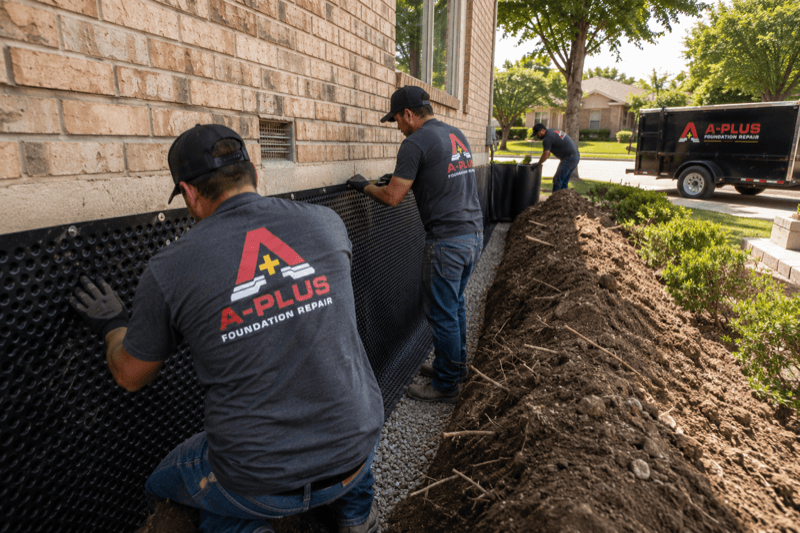
We trench and install deep, impenetrable high-density polyethylene (HDPE) barriers that force roots safely downward, protecting your Fort Worth foundation without harming your beautiful mature trees.
A call we get regularly from Fort Worth is a historic-district homeowner who has been told the house needs to be fully releveled. Often it does not. A structure that settled gradually over ninety years has adjusted to its position, and forcing it back to dead level cracks plaster and breaks original windows. We recover what the building can safely take and stop there.
Protecting your property value in Fort Worth
Mature trees add massive curb appeal and value to Fort Worth properties, but not if they are destroying the house. Our root barriers allow you to keep your beautiful landscaping while permanently protecting the structural integrity of your most valuable investment.
Permits and inspections in Fort Worth
Structural foundation repair generally requires a permit across Tarrant County municipalities, and larger scopes often call for an engineer's report as well. Fort Worth also maintains historic districts where work can carry additional review. We confirm exactly what applies to your address and your scope before scheduling, pull the permit, and see the inspection through.
Where we do root barrier installation in Fort Worth
We work the full city, from the historic Southside up through Alliance, and out into the surrounding Tarrant County communities.
- Fairmount
- Ryan Place
- Arlington Heights
- TCU / Bluebonnet Hills
- Wedgwood
- Westover Hills
- Alliance / North Fort Worth
Root Barrier Installation in Fort Worth: Frequently Asked Questions
Specific answers about root barrier installation for Fort Worth homeowners, including local soil conditions, permitting in Tarrant County, and what drives the price.
How do tree roots damage a foundation?
A mature tree draws a very large volume of water out of the soil each day. During a dry summer its roots extend toward whatever moisture remains, which is often the soil under your slab. As those roots pull water out, the clay contracts and that section of the foundation loses support and drops, producing settlement in one localized area.
Do I have to remove my tree?
Usually not, and that is the point of a barrier. A root barrier redirects root growth downward and away from the foundation so you keep the tree, the shade, and the curb appeal without the structural risk. Removal is a last resort we recommend only when a tree is too close and already causing active damage.
How close is too close for a tree to a foundation?
A useful rule of thumb is that a tree should be at least as far from the house as its mature canopy is wide, and large species such as live oaks and elms need considerably more room. Trees planted closer than that are not automatically a problem, but they are the ones most worth protecting against with a barrier.
How deep does a root barrier need to be?
Deep enough to intercept the roots that matter, which typically means several feet. A shallow barrier simply gets grown under. We set the depth based on the species, the size of the tree, and the soil profile at your property.
Why is root barrier installation needed so often in Fort Worth?
Fort Worth sits on the Fort Worth Prairie, where a layer of expansive clay covers limestone bedrock. That clay still shrinks and swells with the seasons, but the depth to competent rock varies sharply from one side of town to the other. Homes in Fort Worth sit directly on that ground, and root barrier installation addresses the damage it causes rather than just the cosmetic symptoms above it.
How much does root barrier installation cost in Fort Worth?
Pricing depends on the size of the affected area, how far the structure has moved, and what the clay over limestone beneath your property requires. We do not quote Fort Worth jobs over the phone without measuring, because a number given sight-unseen is a guess. Evaluations are free and the written estimate is what you pay.
Do I need a permit for root barrier installation in Fort Worth?
Structural work generally requires a permit in Tarrant County municipalities, and some cities also require an engineer's report. We pull whatever permits Fort Worth requires as part of the job. Non-structural work such as flatwork or drainage may have different requirements, and we confirm before starting.
How quickly can you get to my Fort Worth property?
Fort Worth is inside our regular service area and we schedule evaluations there continuously. Call (972) 436-2595 and we will book the soonest available slot. If you have an active, fast-moving problem, tell us when you call and we will prioritize it.
Is root barrier installation in Fort Worth covered by a warranty?
Our foundation leveling work carries a Lifetime Transferable Warranty, and other services carry warranties appropriate to the work performed. We explain exactly what your Fort Worth job is covered for, in writing, before you sign anything.
Thousands of Satisfied DFW Homeowners
Don't just take our word for it. See why A+ Foundation Repair is the highest-rated structural contractor in Fort Worth.
Trusted by Homeowners
Don't just take our word for it. See what our clients are saying.
Texas Weather Changes Fast. Don't Wait.
Foundation damage doesn't fix itself—it only gets more expensive. Protect your home's value before the next heavy rain cycle shifts your soil. Get a completely free, no-pressure structural evaluation today.