
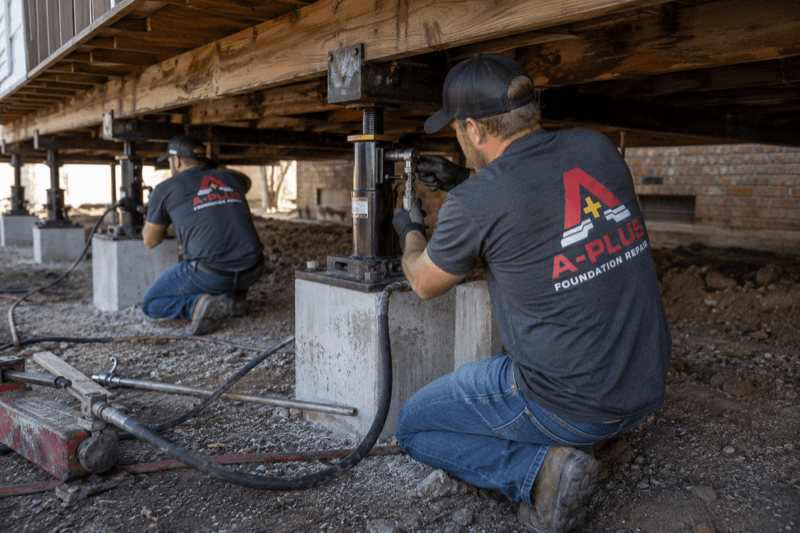
The Hidden Danger Destroying Homes in Fort Worth
Older pier and beam homes in Fort Worth are constantly fighting moisture. High humidity in your crawl space causes main sill beams to rot, leading to dangerously bouncy, sinking floors.
Fort Worth's pre-war neighborhoods are largely pier and beam, and in Fairmount and Ryan Place we spend as much time on rotted sill beams and settled interior piers as we do on anything structural. Post-1980 construction on the north and west sides is slab-on-grade, and those homes present the standard perimeter settlement pattern instead. The repair method follows the foundation type, not the ZIP code.
Why Waiting Will Cost You Thousands
Foundation failure doesn't fix itself; it accelerates. What starts as a hairline crack in your drywall can quickly turn into thousands of dollars in sheared plumbing lines beneath your slab. The longer you wait to address the shifting soil in Fort Worth, the more expensive the collateral damage becomes. A+ Foundation Repair offers free evaluations to catch these issues early.
"A+ Foundation Repair completely saved our home. The cracks in the brick were terrifying, but their crew came out to Fort Worth, explained everything clearly, and the repair was flawless. I can finally sleep at night knowing our home is secure."
- Verified Customer in North TexasThe Science of Fort Worth Soil
Unlike slabs, pier and beam homes in Fort Worth have a crawl space that acts as a trap for humidity. When the Texas heat combines with poor drainage, the trapped moisture creates the perfect environment for wood-rot fungi and termites. A+ Foundation Repair addresses both the structural failure and the environmental cause.
The city sits on the Fort Worth Prairie, where a mantle of expansive clay covers limestone bedrock of the Walnut and Goodland formations. What matters practically is the depth to that rock: on the west side it can be shallow enough that piers reach refusal quickly, while east toward the Trinity the clay runs considerably deeper. Two homes on the same street can need different pier depths, which is why a quote given over the phone for a Fort Worth address is a guess.
The Trinity River and its tributaries cut through the city, and lots near those corridors deal with a different moisture regime than the prairie above them. Fort Worth's older neighborhoods also predate modern lot grading requirements, so we frequently find homes where the yard slopes back toward the house and has for eighty years.
Independent sources: soil classifications for Tarrant County can be looked up through the USDA Web Soil Survey, and Texas A&M AgriLife Extension publishes guidance on managing expansive soils around Texas foundations.
The A+ Foundation Repair Difference
Our structural carpenters replace rotting timber with premium treated lumber, install new concrete footings, and properly ventilate your Fort Worth crawl space to prevent future degradation.
A call we get regularly from Fort Worth is a historic-district homeowner who has been told the house needs to be fully releveled. Often it does not. A structure that settled gradually over ninety years has adjusted to its position, and forcing it back to dead level cracks plaster and breaks original windows. We recover what the building can safely take and stop there.
Protecting your property value in Fort Worth
Sagging floors immediately signal neglect to potential buyers. Restoring your pier and beam foundation with A+ Foundation Repair ensures your historic or custom home in Fort Worth remains a high-value asset, structurally sound for generations to come.
Permits and inspections in Fort Worth
Structural foundation repair generally requires a permit across Tarrant County municipalities, and larger scopes often call for an engineer's report as well. Fort Worth also maintains historic districts where work can carry additional review. We confirm exactly what applies to your address and your scope before scheduling, pull the permit, and see the inspection through.
Where we do pier and beam repair in Fort Worth
We work the full city, from the historic Southside up through Alliance, and out into the surrounding Tarrant County communities.
- Fairmount
- Ryan Place
- Arlington Heights
- TCU / Bluebonnet Hills
- Wedgwood
- Westover Hills
- Alliance / North Fort Worth
Pier & Beam Repair in Fort Worth: Frequently Asked Questions
Specific answers about pier and beam repair for Fort Worth homeowners, including local soil conditions, permitting in Tarrant County, and what drives the price.
How do I know if my pier and beam foundation needs repair?
Bouncy or sagging floors, visible dips toward the center of the house, doors that stick at the top, and a musty smell from the crawl space are the usual signs. Because a pier and beam structure is accessible from below, a crawl space inspection tells us far more, far faster, than we can learn from a slab home.
What causes sill beams and joists to rot?
Trapped moisture. When a crawl space has poor ventilation, poor drainage, or standing water after rain, humidity stays high and wood-rot fungi thrive. Texas heat accelerates it. The structural repair fixes the damaged wood; correcting the moisture source is what stops it from happening again.
Can you repair just the damaged sections, or does everything need replacing?
In most cases we replace only what is compromised. We probe the beams and joists to establish how far the damage extends, replace those members with treated lumber, and leave sound structure in place. Wholesale replacement is occasionally warranted on badly neglected homes, but it is not our default recommendation.
How much does pier and beam repair cost?
It depends on how much wood needs replacing, how many piers need to be reset or added, and how accessible the crawl space is. A tight crawl space takes longer to work in and that affects labor. We give you a written scope after inspecting beneath the home, with the specific members to be replaced identified.
Why is pier and beam repair needed so often in Fort Worth?
Fort Worth sits on the Fort Worth Prairie, where a layer of expansive clay covers limestone bedrock. That clay still shrinks and swells with the seasons, but the depth to competent rock varies sharply from one side of town to the other. Homes in Fort Worth sit directly on that ground, and pier and beam repair addresses the damage it causes rather than just the cosmetic symptoms above it.
How much does pier and beam repair cost in Fort Worth?
Pricing depends on the size of the affected area, how far the structure has moved, and what the clay over limestone beneath your property requires. We do not quote Fort Worth jobs over the phone without measuring, because a number given sight-unseen is a guess. Evaluations are free and the written estimate is what you pay.
Do I need a permit for pier and beam repair in Fort Worth?
Structural work generally requires a permit in Tarrant County municipalities, and some cities also require an engineer's report. We pull whatever permits Fort Worth requires as part of the job. Non-structural work such as flatwork or drainage may have different requirements, and we confirm before starting.
How quickly can you get to my Fort Worth property?
Fort Worth is inside our regular service area and we schedule evaluations there continuously. Call (972) 436-2595 and we will book the soonest available slot. If you have an active, fast-moving problem, tell us when you call and we will prioritize it.
Is pier and beam repair in Fort Worth covered by a warranty?
Our foundation leveling work carries a Lifetime Transferable Warranty, and other services carry warranties appropriate to the work performed. We explain exactly what your Fort Worth job is covered for, in writing, before you sign anything.
Thousands of Satisfied DFW Homeowners
Don't just take our word for it. See why A+ Foundation Repair is the highest-rated structural contractor in Fort Worth.
Trusted by Homeowners
Don't just take our word for it. See what our clients are saying.
Texas Weather Changes Fast. Don't Wait.
Foundation damage doesn't fix itself—it only gets more expensive. Protect your home's value before the next heavy rain cycle shifts your soil. Get a completely free, no-pressure structural evaluation today.